
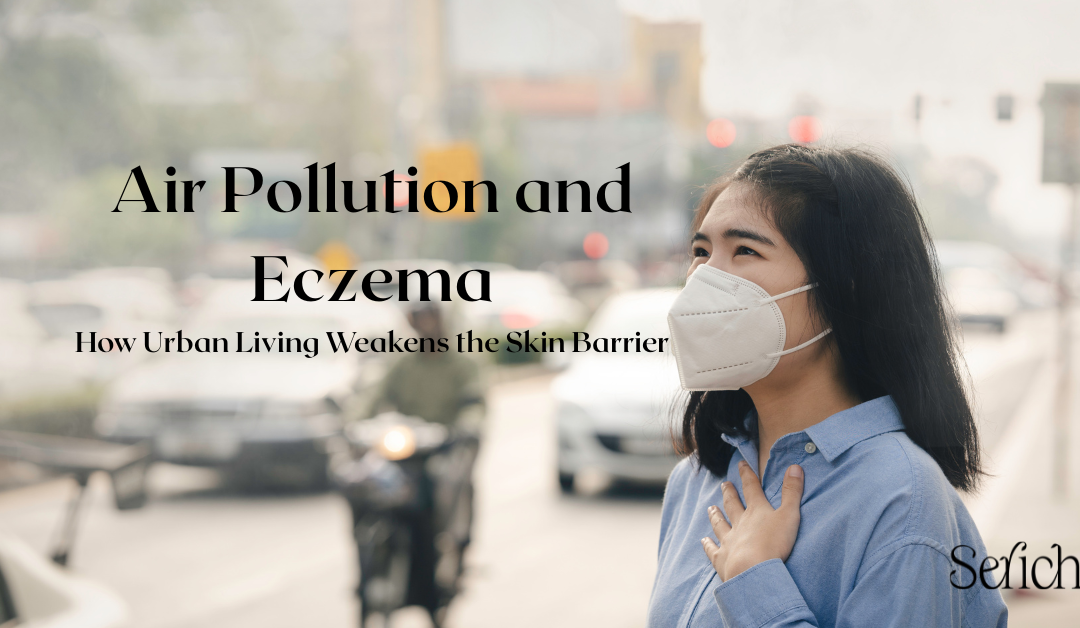
Air Pollution and Eczema: How Urban Living Weakens the Skin Barrier
Living in a modern city brings convenience, connectivity and opportunity, but it also exposes the skin to environmental stressors that are easy to underestimate. For individuals with eczema prone or highly sensitive skin, air pollution is one of the most persistent and invisible triggers affecting daily skin comfort.
Pollution related skin stress does not usually appear overnight. Instead, it gradually weakens the skin barrier, increasing dryness, irritation and reactivity. Understanding how air pollution interacts with eczema prone skin helps explain why flare patterns often worsen in urban environments and why barrier focused care is essential.
Table of Contents
- Why eczema prone skin is more vulnerable to pollution
- How air pollution damages the skin barrier
- The role of inflammation and nerve sensitivity
- Why city living makes eczema harder to manage
- Supporting the barrier against pollution stress
- Daily habits that reduce pollution related irritation
- Understanding limits and seeking professional advice
- A long term approach to urban skin resilience
Why eczema prone skin is more vulnerable to pollution
Eczema prone skin already has a compromised barrier structure. The outer layer of the skin struggles to retain moisture and protect against environmental aggressors. This makes it more susceptible to external stressors such as particulate matter, exhaust emissions and industrial pollutants.
In urban settings, microscopic particles known as PM2.5 and PM10 are small enough to settle on the skin surface and interact with the barrier. While healthy skin may tolerate this exposure more effectively, eczema prone skin allows these particles to penetrate more easily, increasing oxidative stress and inflammation signals.
How air pollution damages the skin barrier
Air pollutants affect the skin through several overlapping mechanisms. One of the most significant is oxidative stress. Pollutants generate free radicals on the skin surface, which damage lipids, proteins and structural components within the barrier.
For eczema prone individuals, this oxidative damage further reduces ceramides and natural moisturising factors that are already deficient. As a result, the skin loses water more rapidly and becomes more permeable to irritants.
Pollution exposure has also been shown to disrupt the balance of the skin microbiome. When beneficial microorganisms are reduced, opportunistic bacteria may become more dominant, contributing to irritation and discomfort.
The role of inflammation and nerve sensitivity
Pollution does not only affect the physical barrier. It also influences the skin’s immune response. Repeated exposure can activate inflammatory pathways, increasing redness and itch sensitivity.
This is particularly relevant for eczema prone skin, where nerve endings are closer to the surface due to barrier thinning. Pollutant induced inflammation can heighten itch perception, leading to scratching cycles that further damage the barrier.
Over time, this creates a feedback loop where environmental exposure, barrier weakness and inflammation reinforce one another.
Why city living makes eczema harder to manage
Urban environments combine multiple stressors. Air pollution is often accompanied by heat, humidity, air conditioning and indoor pollutants. These factors collectively challenge the skin barrier throughout the day.
In Singapore and similar cities, high humidity can increase sweat retention on the skin. Sweat can bind pollutants to the surface, prolonging contact and increasing irritation risk for eczema prone individuals.
Indoor environments also matter. Volatile organic compounds from cleaning agents, furnishings and office equipment contribute to daily exposure even when outdoors air quality appears acceptable.
Supporting the barrier against pollution stress
Reducing exposure is only part of the solution. For most urban residents, complete avoidance of pollution is unrealistic. Instead, strengthening the skin barrier becomes the primary protective strategy.
Barrier supportive skincare focuses on replenishing lipids, maintaining hydration and supporting the microbiome so the skin can better tolerate environmental stress. Ingredients such as ceramides, cholesterol and postbiotics help reinforce the barrier structure and improve resilience.
SERICH Second Skin Moisturising Cream was developed with urban sensitive skin in mind. Its microbiome aligned formulation supports barrier recovery without fragrance or unnecessary irritants, making it suitable for daily use in polluted environments. Rather than claiming to block pollution, it focuses on strengthening the skin’s natural defences so it can respond more effectively.
Daily habits that reduce pollution related irritation
Gentle cleansing plays a role in removing surface pollutants without stripping the barrier. Over cleansing or harsh surfactants can worsen barrier loss, especially for eczema prone skin.
Applying moisturiser consistently, particularly after cleansing, helps restore barrier lipids that are depleted by pollution exposure. This routine becomes even more important during periods of poor air quality.
Clothing and lifestyle choices also contribute. Reducing prolonged outdoor exposure during high pollution periods and rinsing skin after heavy exposure can help minimise cumulative stress.
Understanding limits and seeking professional advice
While barrier supportive care is essential, it has limits. Persistent or worsening eczema symptoms should be evaluated by a healthcare professional. Signs such as severe inflammation, oozing or secondary infection require medical attention.
Skincare and environmental management support the skin but do not replace clinical treatment when needed.
A long term approach to urban skin resilience
Managing eczema prone skin in a polluted environment is not about eliminating every trigger. It is about reducing daily burden and strengthening the skin’s capacity to cope.
Air pollution is an unavoidable reality for many people. By understanding its effects on the skin barrier and adopting a barrier first approach, individuals can improve comfort and resilience over time.
SERICH approaches sensitive and eczema prone skin with this long view. By focusing on barrier integrity, microbiome balance and everyday exposures, it supports skin that can adapt more confidently to modern urban life.
You may wish to learn more about SERICH Moisturising Cream, developed to support the skin barrier with science led formulation. It is fragrance free, steroid free,cruelty free, vegan, approved by PETA, EWG Verifiedand made in Singapore.

FAQ Eczema and Moisturising Cream: How to Choose the Right One for Barrier Repair
What is the best moisturising cream for eczema? Learn how moisturisers support the skin barrier, reduce itching and improve eczema comfort with science-led guidance.

Steroid-Free Skincare for Eczema: What to Look for and Why It Matters
Learn why steroid-free skincare matters for eczema-prone skin and what to look for in a safe, effective daily moisturiser. A guide for long-term skin health.

Skin Microbiome and Eczema: How Good Bacteria Help Calm Sensitive Skin
Learn how your skin microbiome affects eczema-prone skin and why post-biotics are essential for calming sensitivity and supporting healthier skin long-term.

CNA938 Rewind – The Wellness Hour – The Science Behind Steroid-free Eczema Relief
Eczema can be difficult to manage over the long term, especially for people with sensitive or eczema-prone skin who want relief and steroid-free. Listen to podcast by CNA938.

Skin Barrier Repair for Eczema-Prone Skin: Why Ceramides and Post-Biotics Matter
Discover how ceramides and post-biotics support skin barrier repair for eczema-prone skin. Learn why steroid-free skincare matters for long-term skin health.

Eczema and Hormonal Changes: What Happens During Stress, Cycles and Ageing
Hormonal changes can worsen eczema during stress, menstrual cycles, pregnancy and ageing. Learn how hormones affect the skin barrier and what eczema-prone skin needs.


